
5.1 Market price of Perishable vs Durable goods
| Perishable goods | Durable goods | |
|---|---|---|
| Meaning | Spoil fast, cannot be stored | Last long, can be stored |
| Examples | Milk, fruit, vegetables, fish | Machinery, motorbikes, mobile phones, printers |
| Supply curve | Vertical (fixed amount must be sold now) | Normal upward slope — then vertical when stock runs out |
| Who decides price? | Demand only (demand is dominant) | Both demand and supply |
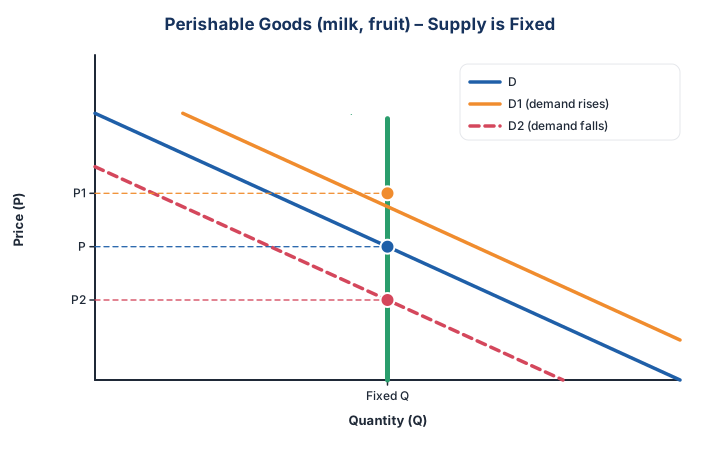
The green supply line is vertical: the seller has a fixed amount (e.g. today's milk) and must sell all of it today — he cannot store it.
So price is decided by demand alone. Demand rises (D1) → price jumps to P1. Demand falls (D2) → price drops to P2. Quantity stays the same.
This is why vegetable prices go up and down so much day to day (MCQs 33 and 41).
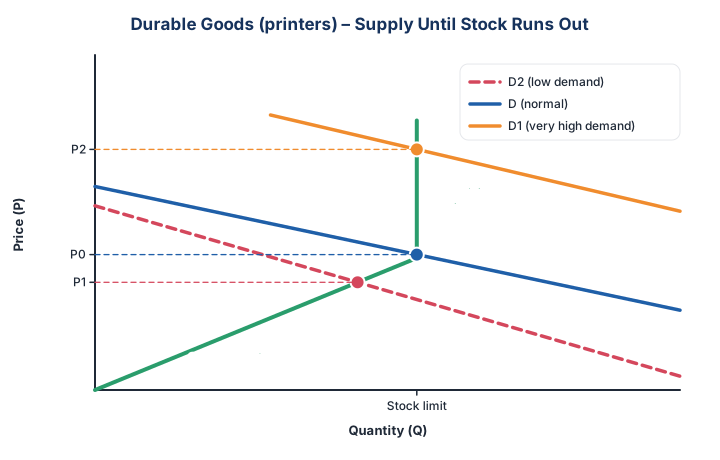
While there is still stock in the store, sellers can bring more printers when price rises → the supply curve slopes upward.
Once the stock is finished, no more can be supplied → supply becomes vertical.
Low demand (D2) gives price P1; normal demand (D) gives P0. Very high demand (D1) hits the vertical part, so price jumps sharply to P2.
5.2 Reservation Price
The reservation price (reserve price) is the lowest price at which a seller is willing to sell. Below this price, the seller will NOT sell.
You are selling your old phone. You decide: “I will not sell below Rs. 20,000.” Rs. 20,000 is your reservation price. If someone offers Rs. 25,000 you happily sell; if they offer Rs. 15,000 you refuse. For firms, the reservation price depends mostly on cost of production (MCQ 18).
5.3 Price Mechanism, Price Instability & Role of Government
Normally the price mechanism works well. But sometimes the market gives prices that are unfairly high for buyers or unfairly low for sellers, and powerful people can exploit weaker ones. This happens a lot in agriculture.
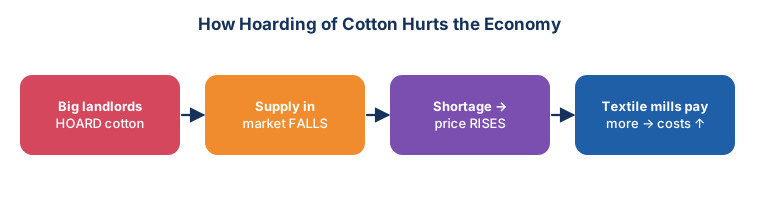
Big landlords hold back cotton on purpose → less cotton in the market → shortage → price rises → textile mills must pay more → their production costs rise, and the effect spreads to cloth prices too.
Sugar cane cartel: sugar mill owners secretly agree not to buy sugar cane this season. After the harvest, farmers have lots of cane and no buyers → surplus → the price of cane crashes, and farmers suffer.
Solution: the government should step in and set legal limits on how high or low prices can go.
Why farm prices and incomes are unstable
- Long time between planting and harvest: farmers cannot know the final output in advance.
- Weather and other outside factors decide how big the harvest is, so the supply curve keeps shifting year to year.
- Once harvested, the crop must be sold for whatever price it gets.
- Demand for food is inelastic (food is a necessity, so people buy about the same amount whatever the price).
- So when supply shifts, price changes a lot. A bumper (good) harvest can crash prices so much that farmers end up earning less — the “irony” of farming.