
6.1 Buffer Stock Scheme
A buffer stock scheme is when the government buys and stores a commodity (e.g. wheat) to keep its price stable. The government sets a minimum price (floor price) above the market price and buys any surplus at that price.
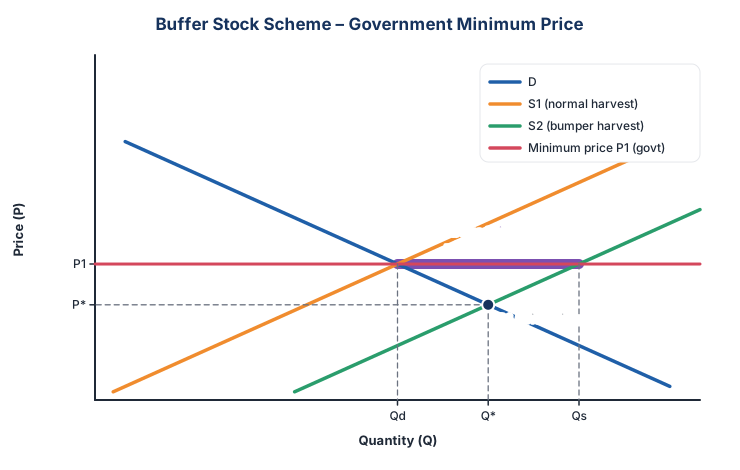
Normal harvest: supply S1 meets demand D at price P1.
Bumper harvest: supply shifts right to S2. With no government, price would crash to P* — farmers lose income.
Government promises price P1 (red line). At P1 buyers want only Qd, but farmers supply Qs.
Government buys the surplus (Qs − Qd) — the purple band — and stores it. Farmers get a stable price.
In a bad year (shortage), the government releases the stored stock to stop prices rising too much.
| Advantages ✔ | Disadvantages ✘ |
|---|---|
| Stable prices for consumers | High opportunity cost – money spent buying and storing could be used for schools, hospitals etc. |
| Stable, predictable income for farmers | Over-production – farmers grow too much because the price signal no longer works |
| Stock can be used in a future shortage | Administrative & storage costs – godowns, staff, wastage |
Buffer stock aims to: protect producers, encourage production, and keep prices stable → MCQ 17 answer is “All of the above.” Its problem is over-production (MCQ 19 → a).
6.2 Price Floor and Price Ceiling
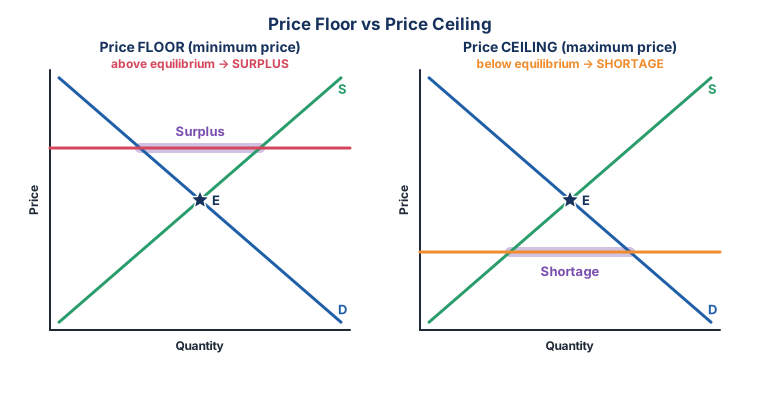
Left – Price floor (minimum price): must be set ABOVE equilibrium to have any effect. At this high price, sellers supply more than buyers want → surplus. Examples: support price of wheat; minimum wage above equilibrium → surplus of labour = unemployment (MCQ 37).
Right – Price ceiling (maximum price): set BELOW equilibrium. At this low price, buyers want more than sellers supply → shortage (MCQ 36). Example: government-fixed flour price leading to queues.
| Price floor | Price ceiling | |
|---|---|---|
| Meaning | Legal minimum price | Legal maximum price |
| Where it is set | Above equilibrium | Below equilibrium |
| Result | Surplus (QS > QD) | Shortage (QD > QS) |
| Who it protects | Producers / workers | Consumers |
| Example | Wheat support price, minimum wage | Government-fixed flour price |
Floor = above → Surplus. Ceiling = below → Shortage. (A floor is something you stand ON, so it holds the price UP. A ceiling is ABOVE your head, it stops the price going higher.)
The government usually picks one of these for a product — a ceiling (legal maximum) or a floor (legal minimum).