
This is the most important (and most confusing) idea of the chapter. Use this simple test:
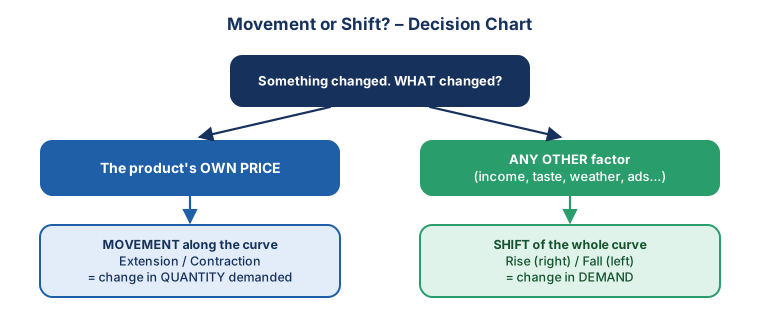
Start at the top: ask what changed.
If only the product's own price changed → we move along the same curve (extension / contraction = change in quantity demanded).
If any other factor changed (income, taste, weather, ads…) → the whole curve shifts (rise / fall = change in demand).
| Movement along the curve | Shift of the curve | |
|---|---|---|
| Caused by | Change in the product's OWN price only | Change in any other factor (income, taste, weather…) |
| Name | Change in quantity demanded | Change in demand |
| Words used | Extension (price ↓, buy more) Contraction (price ↑, buy less) | Rise / Increase (curve moves right) Fall / Decrease (curve moves left) |
| Graph | Same curve, point slides from a to b | Whole new curve D1 → D2 |
Movement along the demand curve
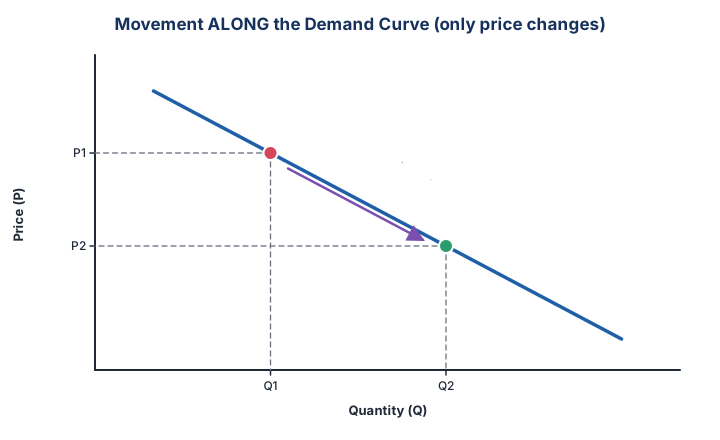
There is only one curve D. Nothing else changed — only the price of room coolers.
At high price P1 people buy Q1 (point a). When price falls to P2 they buy more, Q2 (point b).
Going a → b = extension of demand. Going b → a = contraction.
Shift of the demand curve
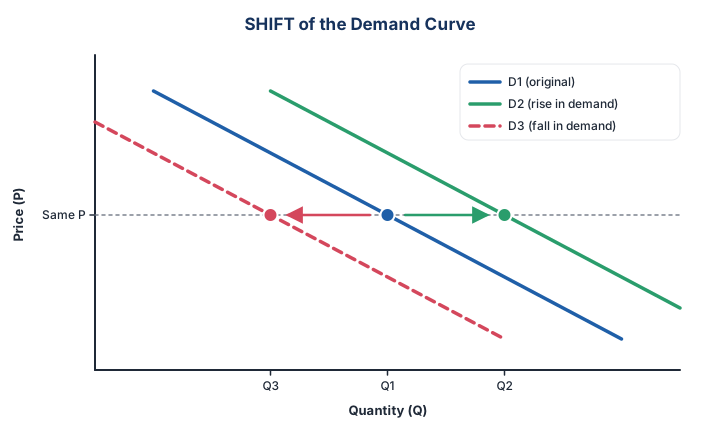
Look at the dotted line: the price stays the same, but quantity changes. That's how you know the curve shifted.
Summer arrives → people want more coolers at every price → curve moves right from D1 to D2 = rise in demand (Q1 → Q2).
Winter arrives → less wanted at every price → curve moves left to D3 = fall in demand.
Factors that SHIFT the demand curve
| Factor | Rise in demand (shift right) when… | Example |
|---|---|---|
| Income | Income goes up (for normal goods) | Salary rises → people buy more meat |
| Taste / fashion | Product becomes popular | New trend makes a sneaker brand popular |
| Weather / season | Weather suits the product | Winter → more tea/coffee; summer → soft drinks |
| Population | Population grows | More people in town → more demand for houses |
| Price of substitute | Substitute becomes more expensive | LG prices rise → people buy more Samsung |
| Price of complement | Complement becomes cheaper | Petrol cheaper → more demand for cars |
| Advertising | Successful advert campaign | Big TV ad → more sales |
| Expectations | People expect price to rise in future | Expect petrol price hike → fill tank today |
Substitute price ↑ → our demand ↑ (same direction). Substitute price ↓ → our demand ↓ (MCQ 3).
Complement price ↑ → our demand ↓ (opposite direction). Tea price falls → more tea → more demand for cups, less demand for coffee (MCQ 30).
Use the Shift Simulator: pick an event, predict which curve moves, then watch it happen.