
Individual demand vs Market demand
| Individual demand | Market demand |
|---|---|
| Demand of one consumer / household | Total demand of all consumers in the market |
| Example: Mr. A buys 20 kg at Rs. 400 | Mr. A + Mr. B + Mr. C = 42 kg at Rs. 400 |
Definition
Market demand curve = horizontal summation of individual demand curves. “Horizontal” means: at each price, we add the quantities (which are measured sideways on the X-axis). We never add prices.
| Price (Rs./kg) | Mr. A | Mr. B | Mr. C | Market demand (A+B+C) |
|---|---|---|---|---|
| 500 | 10 | 5 | 6 | 21 |
| 400 | 20 | 10 | 12 | 42 |
| 300 | 35 | 25 | 20 | 80 |
| 200 | 55 | 40 | 30 | 125 |
| 100 | 80 | 60 | 45 | 185 |
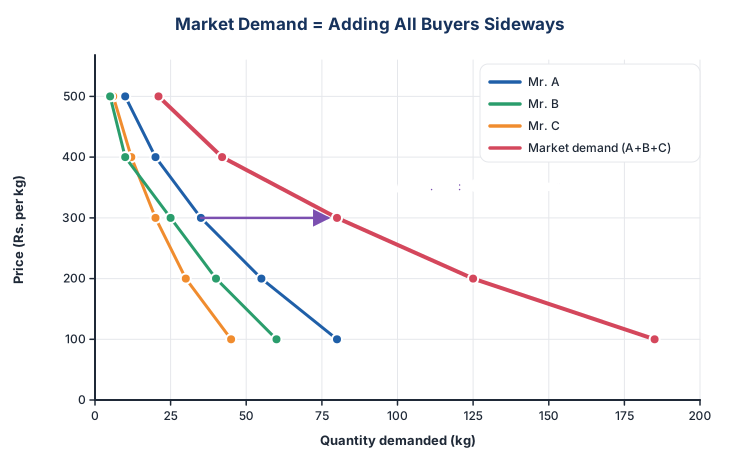
How to read this graph
Blue, green and orange lines are the three buyers. The red line is the market.
Look at price Rs. 300: Mr. A wants 35, Mr. B 25, Mr. C 20. Add sideways (purple arrow): 35 + 25 + 20 = 80 kg. That point is on the red market line.
The market curve is always further to the right (bigger quantities) but has the same downward shape.
Exceptions (when the law of demand does NOT work)
| Exception | Why the law fails | Example |
|---|---|---|
| Basic necessities | People buy them anyway, whatever the price | Salt, wheat, sugar, rice |
| Unique / distinctive (prestige) goods | Higher price makes them MORE attractive to rich buyers (show-off) | Diamonds, luxury watches, designer bags |
| Change in income | If income rises at the same time, people buy more even though price rose | Salary increase + price rise together |
| Ignorance of consumer | Buyer doesn't know it is cheaper elsewhere, so price doesn't affect him | Tourist buying at a costly shop |
| Uncertain conditions / fear of shortage | People panic-buy even at high prices | Buying flour before a strike; masks in COVID |
| Giffen goods | Very cheap staple: when its price falls, people buy LESS and switch to better quality | Sir Robert Giffen's bread example (19th century) |
Giffen paradox
Sir Robert Giffen found that when the price of bread fell, demand for it fell — people's real income rose and they bought better-quality food instead.
Practical importance of the law of demand
- Price setting: Producers can see how much sales will change if they raise or cut the price.
- Business planning: Firms use the demand schedule to plan future production, locally and internationally.
- Helps the Finance Minister: If a new tax raises the price so much that demand falls a lot, the tax collects almost no extra money. So the government taxes goods carefully.