
2.0 What is demand?
Demand is the quantity of a good or service that buyers are willing AND able to buy, at a given price, in a given time period.
Every wish is not demand. Wanting something is free — but demand needs money (ability) and willingness too.
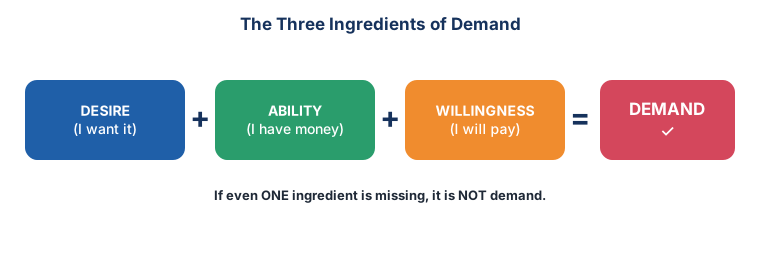
Demand needs all three boxes together: desire (I want it) + ability (I have money) + willingness (I will pay).
If even ONE is missing → it is NOT demand (poor farmer & harvester / student who doesn't want a burger).
Case 1 – Poor farmer: He wants an expensive harvester (desire ✔, willing ✔) but has no money (ability ✘). → No demand.
Case 2 – Student and burger: He has money (ability ✔) but is not in the mood (willing ✘). → No demand.
Case 3 – You buy a burger: You want it, have money and are ready to pay. → This is demand.
A demand schedule is a table that shows different amounts of a product a consumer is willing and able to buy at different prices, in a given time.
2.1 Law of Demand
“When the price of a good rises, ceteris paribus (other things same), the quantity demanded falls — and when price falls, quantity demanded rises.”
In short: Price and quantity demanded have an INVERSE relationship.
Price goes UP ↑ → people buy LESS ↓. Price goes DOWN ↓ → people buy MORE ↑.
Think of a sale at a shop: when prices drop by 50%, crowds come in. That's the law of demand in action.
Why does this happen? Two reasons
| Effect | What happens when price rises | Simple example |
|---|---|---|
| Income effect | You feel poorer. The same money now buys less (your purchasing power falls), so you buy less. | You had Rs. 1,000 for chicken. At Rs. 500/kg you get 2 kg; at Rs. 250/kg you got 4 kg. |
| Substitution effect | The good becomes costly compared to other goods, so you switch to a substitute. | Chicken becomes expensive → you buy more beef, fish or daal instead. |
Income effect + Substitution effect = Price effect. Together they make the demand curve slope downward (useful for MCQ 24).
Assumptions (conditions) of the law of demand
The law works only if these things stay the same (ceteris paribus). If any of these change, the whole curve shifts instead:
- Consumers' income does not change.
- Population does not change.
- Prices of related goods (substitutes and complements) do not change.
- Taste, habits, fashion, and weather do not change.
- People's future expectations about prices do not change.
- Advertising does not change.
Wages, cost of raw material, technology are supply-side things. They are NOT conditions of the law of demand (MCQ 6 answer: wages).
Example: One consumer's demand for chicken
| Price (Rs. per kg) | 500 | 400 | 300 | 200 | 100 |
|---|---|---|---|---|---|
| Quantity demanded (kg) | 10 | 20 | 35 | 55 | 80 |
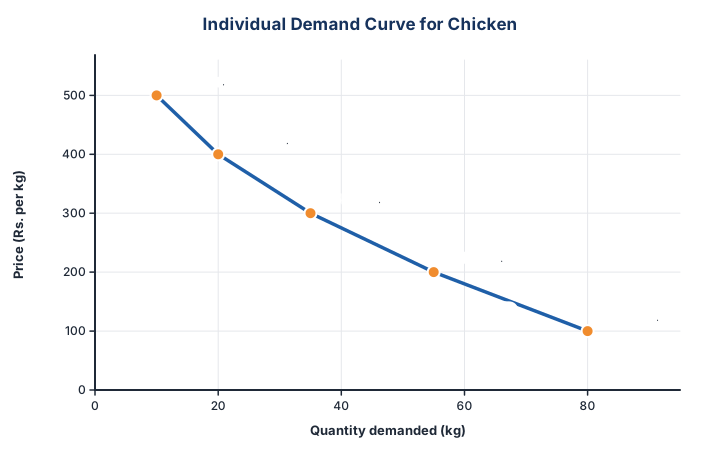
Y-axis (up) = price. X-axis (across) = quantity. Each orange dot is one row of the table.
Joining the dots gives line D, which goes down from left to right (downward sloping).
Top-left dot: high price Rs. 500 → only 10 kg. Bottom-right dot: low price Rs. 100 → 80 kg. Lower price → more bought. That is the law of demand in picture form.
Open the Graph Lab and move the price slider — watch the quantity demanded change along the curve.